
Throwing It All Away

There are certain stories that I reread every few years that I believe to be foundational to my personhood. I find new ways to relate to these books each time I do this. One story in particular, a sci-fi book called The Dispossessed, helped radicalize me as a teenager. After reading it again recently, I’m shocked with how relevant its narrative is to my current predicament. Let’s just say that I’m thinking about quitting my job and living as a vagabond again.

Ursula K. Le Guin’s The Dispossessed is a story about an anarchist society that exists on the barely-habitable moon of a planet similar to our own. More specifically, it is a story about a man’s journey from an anarchist society to a stratified, capitalist society. The story’s main character, Shevek, is the moon colony of Anarres’ first visitor to the planet Urras in almost 200 years, back when his ancestors left the corrupt, hierarchical society to forge a society free from rulers and private property.

A speech Shevek makes within the book resonated with the very depths of my anarchist soul:

“if it is the future you seek, then I tell you that you must come to it with empty hands. You must come to it alone, and naked, as the child comes into the world, into his future, without any past, without any property, wholly dependent on other people for his life. You cannot take what you have not given, and you must give yourself.”

I have always sought a life of freedom in which I can do as I please when I please. For as long as I can remember, I’ve hated the idea of having power over others and people having power over me. I have bucked most attempts people have made to pressure me into acting a certain way, earning me the title of “wild child” by my relatives. My behavior as a child became more and more unmanageable until I became a teenager.

My adolescence in foster care was filled with psychologists telling me that I was mentally ill due to childhood trauma. It was filled with psychiatrists giving me pills to control my unruliness. For a time, I was zombified by those pills. I had everything that made me bright and beautiful taken from me by men and women who claimed to be helping me.

What those people were actually doing was forcing me to conform to the same rules and systems that they’d bought into at some point in their lives; rules of domination and submission. I’ve never believed in such things. When my mother was beating me nearly everyday when I was only a toddler because I did not speak in a way she liked, I knew that what she was doing was wrong. There was no amount of abuse that would force me to believe that others had any right to coerce people into shapes that the abusers deemed acceptable.

Shevek, too was unruly as a child. He questioned things a bit too much and in a manner even his fellow anarchists thought was unacceptable. That questioning nature led Shevek to become a theoretical physicist, one of the best to ever live, even. I also wanted to become a scientist whose efforts led to breakthroughs in our collective understanding of the universe. But in a world like ours, my bucking of convention and authority hobbled me in ways that most people wouldn’t imagine.

I’ve always been academically gifted, but the compulsive nature of school made me very anxious. I barely found respite from the bullies that tormented me severely in elementary and middle school. I didn’t have the freedom to not associate with them. Picking and choosing what type of people a person has to deal with is perhaps one of the greatest things people can do for their mental wellbeing. Sadly, it is a freedom that is only afforded to those with money and power.

College could have been an escape from these things, but it was yet another thing that was forced onto me. I was not ready for the decisions that my high school guidance counselor made for me. I had so many stressful things occurring to me on a daily basis in high school, not to mention that I was hiding the fact that I was in foster care from all of my friends. She truly believed that she was doing something amazing for me and never missed an opportunity to brag about it to others.

Dual-enrollment stated when I was a junior and became another burden that I felt compelled to carry. I’d always been told that college degrees promised higher lifetime income. At 15, I already knew that money could get me the freedom that I’d always longed for. But the degree program that was chosen for me, the one that gave me a full-ride, wasn’t even something that I truly wanted to do. Insult was added to injury when I learned how little money the career offered out of college.

When I graduated a few months before my 19th birthday, I decided to finally live freely. I hitchhiked from Florida to Maine over the course of four months while most of my high school friends were still partying in college. It was an incredible adventure that nearly killed me, but also showed me how kind the average stranger really is. I was constantly being offered to start a new life with people that picked me up, sometimes to even become a part of their families. But I would always keep moving, never staying somewhere longer than two weeks. I was a man obsessed with being free not just from capitalism, but from social obligations.

By the end of that trip, I’d lost 30 pounds off of my already slender body and had only a backpack full of essentials. I was tired and physically weak, but I finally felt good about myself. I ended up going back down to Florida to escape a harsh winter and figure out where I wanted to travel the next spring. I lived in a long-term shelter in Miami where I was abandoned by a cruel man that I thought loved me.

I then went into the Air Force. I went from one extreme to another, as hurt people do. It was almost like I was testing my belief in my own freedom. Let’s just say that the military was one of the most awful experiences I’ve ever had. I got out at the first “honorable” opportunity.

Life since then has been a fight between living with convenience vs living authentically. Convenience has won out more often than not. Living on the streets in an increasingly psychopathic society gets harder and harder to manage. Add aging and failing health to the equation and it becomes clear why I’ve continued to seek out “the easy life”. I am currently still selling my time for money so that I can keep myself well-fed and comfortable.

***

As I write this, I’m grieving the death of a man whose name I will probably never know. It may be cliche but I’m met with a sense of my own mortality. I was the numbest I’ve ever been in my life before this man’s demise. I went from feeling like I’d genuinely helped save someone’s life to hearing that he’d passed away in a hospital as a John Doe. Shevek had a similar experience in the climax of The Dispossessed, shortly after he’d made his speech. It shakes everything you’ve believed and accepted about life and yourself to the very core.

I hate my job. I hate my city. I hate my home, and I may even hate myself. I have become a person who has traded his essence for comfort and convenience. I am a person who has surrounded himself with people that reinforce that lifestyle, who actively discourage me from abandoning it even when they see how much it is killing me. Each week at my job is spent turning away more people in need than I can actually help. I have gained 30 pounds and my health has fallen off a cliff.

While Shevek is living on Urras, he is wined and dined by the elites there. He too gains some weight as he feels the poison of their cruel culture seeping into his being. They wish to own him and the ideas in his mind. They bribe him with money and possession, wishing for him to become a property-owner like themselves. But when he finds people on Urras who long to be free like his own people on Anarres, he joins them in the streets even when his own life is at risk.

I have also helped groups that share my anarchist beliefs, but it feels so futile to work within a vile, psychopathic system that resists and even absorbs any attempts to subvert it. Shevek arrives at the same conclusion. After several months of increasingly dramatic experiences amongst the “propertarians” of the planet, Shevek returns to his home on Anarres. He doesn’t take anything back with him from the planet except for his experiences and a renewed appreciation for and an expanded understanding of his culture. Anarres may not be a utopia to Shevek but it is better than the hellish “civilizations” of Urras.

Shevek sees how futile resistance against the hierarchical structure of Urras truly is when its governments can simply mow down resistors en masse. He realizes that if freedom exists, it only exists independent of those governments and free from their greedy, violent hands. Anarres’ people have their own unspoken social order that feels stifling at times. Anarres doesn’t, however, have groups of people with so much power that they can order the deaths of thousands on a whim.

It has always felt like I was born on a distant anarchist colony. There is the ideal that exists in my head that feels almost as real as a physical place, but that ideal cannot provide me with food and shelter. My beliefs cannot sustain me like a friendship can, like a community can. I wish that I could throw everything I have away and live with empty hands, relying solely on other people. But there is no Anarres in our universe; not one that I can get to, anyway.

In The Dispossessed, Anarres was born from the writings of a revolutionary thinker. I guess I’ll start there.

Accelerating into Nothingness

Accelerationists strive to remove the “guard-rails” of society, like democratic processes and regulations, in order to rapidly bring about a future of technological advancement that will transform humanity or even supplant us entirely. The concept exploded in mainstream understanding and popularity in the last 20 years thanks to some of the tech elite in Silicon Valley stating openly that their goals align with accelerationism. When accelerationism was first described, it was a vague sci-fi term for a supposed tech utopia that we should strive for no matter how much it may change our civilization. Now that we are all living in the AI era, such goals are becoming a lot less esoteric.

Accelerationist thought leaders like Nick Land have written extensively about their ideas, many of which borrowed from cyberpunk and earlier philosophers like Marx and Nietzsche. Land and others like him founded a collaborative “theory-fiction” group known as the CCRU in 1993, where they expanded on their nihilist, anti-humanist views. These accelerationists saw the processes behind technological and capitalistic development as deterministic and intelligent. They saw humans as mere cogs in these machines that only served to increase machinic complexity. Techno-utopian imaginings like fully-automated luxury communism can be seen as the complete opposite to the CCRU’s techno-nihilist views. To these early accelerationists, humans were something to be wiped away by the ascendant machine intelligence.

As the years passed and technology developed in strange and destructive ways, many accelerationists’ beliefs became increasingly religious and occult, as did their belief in the folly of human existence. Instead of seeing technology as a form of human liberation, many accelerationists saw it as a tool to remove stupid, weak humans from the world entirely. Gone were the mechanistic views of a fated, amoral end to humanity. Accelerationism turned neo-reactionary.

Capitalism is very good at dismantling social norms and destabilizing cultures and the territories where they are normally rooted. It is good at creating ever-evolving forms of globalized efficiency that are increasingly detached from the realities of human life. Because of this, accelerationists view capitalism as the perfect tool to destroy the limitations placed on technological development.

Accelerationists don’t want democracies where unintelligent, uninformed people make collective decisions that limit growth. Accelerationists don’t want environmentalists that pressure governments to regulate the excesses of industry that poison and even destroy our habitats. Accelerationists don’t want governments at all if it means that highly-efficient systems can improve upon themselves without constraints. All must be dedicated to bringing about the technological singularity, whether we want it to happen or not.

There has been a lot of talk about the “Singularity”, but what is it? It is the use of sufficiently-complex artificial intelligence that is generalized enough to be able to improve upon itself until it is smarter than the totality of humanity. Like a black hole, no one knows what will happen beyond this singularity, or even how it will work. Despite this lack of understanding, some of the most powerful men in the world are using their vast resources to bring about this Singularity. They are getting the world’s globalized financial and industrial systems to funnel an ever-increasing amount of money and infrastructure into the development of artificial intelligence.

It seems as though every tech billionaire with the means to start a competitive AI development business is in a race to become the messiah who brings about an ineffable “Machine God” that will transform the world. Some of these billionaires, like Sam Altman and Sundar Pichai, wish to guide this hyperintelligent AI into having the moral framework of a California Liberal so that it might not simply destroy humanity entirely. Other billionaires, like Elon Musk and Mark Zuckerberg, seem to have more nefarious plans for the apotheosis of their AI systems. Some astute investigators even believe that they discovered Elon Musk’s anonymous 4chan account, in which he discusses his desire to become an AI god that will rule over humanity with an iron fist in a virtual hellscape. When seen through these lenses, one could say that this is a battle of biblical proportions for the fate of humanity.

Regardless of what it may mean now, accelerationism has its origins within a philosophy of nihilism. The academics who brought this idea into the mainstream were motivated by a belief in the meaningless of human existence and by the inevitability of artificial intelligence ridding the world of humanity. Early accelerationists used science fiction like Terminator and Neuromancer in their theories. Nick Land even went so far as to write about capitalism being an alien AI sent from the future. No matter how nerdy and ridiculous this all may sound, these are the views guiding humanity into an uncertain future.

The Generative AI of the Holodeck

When Stable Diffusion started being more accessible to casual coders like me back in 2023, I immediately saw the parallels between that technology and some of the sci-fi tech I grew up with. Typing up a prompt to then have the generative AI spit out a relevant image wasn’t much different to me than the way the crew of the Enterprise would use the holodeck.

In the episode “”11001001” of Star Trek: The Next Generation, Riker says, “Computer – I need a place to play some music – a little atmosphere.” before stepping into a holodeck transformed to suit his needs. He even cleans up his prompt by specifying that he wants the era to be “Circa 1958,” and refines it even more by saying, “Kansas City. No, wait. New Orleans. Yeah. New Orleans — the Low Note. ‘Round midnight”. Once he steps into the jazz bar and marvels at the computer’s work, Riker has it add more things to the room, such as a band and an audience. What the computer is doing is generating content based on Riker’s prompts.

It’s exciting to think that we are living in an age where such foundational, transformative technology is available to us. We stand on the precipice of an Intelligence Revolution that will exponentially increase humankind’s computational ability. We can model complex data and mathematical problems with a simple phrase. We can create engaging images and videos to communicate ideas that we couldn’t articulate to others very well without extensive art training. We can run simple experiments millions of times digitally and observe novel results that would’ve taken us decades to realize in the physical world. The possibilities of this technology seem endless, but its issues are also myriad.

Holodecks are self-contained systems aboard starships and other high-tech facilities. They tend to be about the size of a large living room, though they possess the ability to create environments that perceptually extend vast distances, like entire cities or oceans. Our modern AI technology is a lot more sprawling. Just as early computers were building-sized, so too are the vast data infrastructures that enable AI companies like xAI and OpenAI. These infrastructures span across nations, providing cloud computing as well as a wealth of data storage. Most technology reduces in size as it evolves, a process known as miniaturization. However, the physical structure of AI data infrastructure is expanding at an exponential rate all over the world, consuming more and more resources in the process.

There are the environmental concerns of this tech, such as how entire small towns are being converted into data centers and heat sinks. There are also the issues relating to how this technology is owned by billionaires who already have an outsized amount of power and influence on society. Millions of people are feeding these AI models personal information at a speed unheard of even throughout our social media age, further concentrating vast swathes of sensitive data into the hands of psychopaths and megalomaniacs. And of course there’s the unprecedented amount of digital theft that birthed these generative models, which seemingly used the entire internet to train on.

Despite the ethical challenges of this new technology, generative AI is here to stay. It has brute-forced its way into our society, as has already begun to reshape it. There is no putting the genie back in the bottle, regardless of how much fear and actual harm that it is doing. When there is this much money behind something, its motive force becomes unstoppable, at least in the short term. Many of the innovations that have shaped contemporary civilization have had messy beginnings, such as the tremendous pollution that plastics and other petroleum products have done. Humans have a habit of widely adapting technologies that make their lives easier or more entertaining, and capitalism turbo-charges the availability of those technologies.

I’ve always wondered how humanity gets to these space-faring futures, like in Star Trek. There are many “great men” theories and portrayals in fiction, such as Zefram Cochrane creating warp drive. However, most transformative scientific progress has been slow and collaborative, building upon the knowledge accumulated by humanity over centuries. A few people might make leaps in logic, but those observations are also informed by collaboration with experts in their fields. There would be no Einstein without Grossmann and Hilbert, no Newton without Leibniz and Halley.

Generative AI, when it is less error-prone, offers the ability to collaborate with vast bodies of research and historical knowledge. In this way, it can accelerate our sciences and serve as a quantum leap towards a better, brighter future. However, in its current form, AI technology just isn’t robust or accurate enough to provide this level of scientific collaboration outside of highly-trained, project-specific, and often proprietary models. Imagine being able to work alongside the greatest minds of our era, or creating composite characters of those minds, just as Janeway worked with Leonardo da Vinci within Voyager‘s holodeck.

The holodeck offers a way to turn one’s imagination into something that they can interact with in the real world. Generative AI systems like Stable Diffusion and Gemini can already create images and even videos tailored by our imaginations. The holodeck computer is perhaps the culmination of the generative AI models we are creating today, refined and perfected. Heck, even the replicators would need to use such generative AI to create dishes on the fly with limited audio prompts. Now we just need the antimatter or fusion energy sources, the photonic emitters, the force fields, the matter reconstituters…

Magic the Gathering is a Rules System

There are so many people complaining about Universes Beyond. There are so many people saying that it’s the “end of Magic” or some such nonsense. How many of these people have ever read a Magic novel? How many of them have even read one of the online stories that WotC posts each set?

I think that the core issue with the complaints about Wizards of the Coast prioritizing UB sets is that they miss something vital about the game; Magic the Gathering‘s strength is in its gameplay, not in its creative intellectual property.

WotC used to knock it out of the park with three unique planes each year, during their Block era. They’d have three sets each block that allowed them to tell a fully-fleshed out three-act story with plot progression and character development. “Fatpacks,” as bundles used to be called, included the novels for each of those sets, creating full narratives based in these rich, fantasy worlds. You’d usually see at least one person in your local game store reading one of them during FNM.

If you’d ask the average Magic player even back then what was going on in the block’s story, they’d probably say that they didn’t know. What they did know about were the mechanics of the set and of the block, and how those mechanics affected the formats that they played. What the majority of players have always focused on was the gameplay, not the story, even when the story was good.

Magic the Gathering is a rules system that allows for the most complex gameplay that we’ve ever seen in a largely-played card game. Over the course of 31 years, over 25,000 unique cards (or game pieces, as WotC is known to call them) have been introduced to the game, as well as over 700 unique rules. Despite this incredible level of complexity, MtG continues to be a widely-played game that is picked up by thousands of new players each month. In fact, the game’s complexity is often cited as what attracts new players to the game.

Unlike its competitors, such as Yu-Gi-Oh! and Pokemon, Magic the Gathering has never had large success in adapting its creative IP across many forms of media. Despite its comic books, video games, and decades of novels, MtG’s characters and stories have failed to gain wider cultural appeal. WotC has tried for over 30 years to have their creative elements become apart of the mainstream, but no matter what they try, it has always seemed like a struggle with minimal benefits. WotC’s worldbuilding has won the praise of creative critics but it has merely existed as a vehicle for MtG’s gameplay. It is not MtG’s head creative who represents the game’s department but its head designer, Mark Rosewater, a person in charge of gameplay.

The introduction of playable, externally licensed creative intellectual property into Magic the Gathering came as a alt-art, subtitled Godzilla-themed cards in the Ikoria set back in 2020. These cards had mixed reviews when they were spoiled, but were quickly accepted and even celebrated by the larger player base. However, there were many players who saw such licensing as dangerous to the “purity” of the game and its own IP. These concerns were seemingly validated within the same year with the release of the mechanically-unique The Walking Dead cards. Players were very vocal about their distaste of having such cards in the game, especially since they were only available through the new limited-time, direct-to-consumer Secret Lair product line.

Despite WotC eventually creating “in-universe” versions of The Walking Dead cards, player trust had already been eroded. The next year brought Dungeons and Dragons sets, which were well-regarded gameplay-wise. Since the IP was within WotC’s portfolio, it was seen as more of a “sister-property” to that of MtG, but there were still Magic purists who were quite vocal about their dislike of an entire Standard-legal set being dedicated to a non-MtG IP. More mechanically-unique cards would come out in the following years, adding fuel to the fire. But despite all the criticism, these sets and Secret Lair bundles led to record-sales time and time again for WotC, and therefore Hasbro, their corporate owners. The incentive for WotC to delve more into what they called “Universes Beyond” became greater until it all came to a head with their best-selling set ever at the time, The Lord of the Rings: Tales of Middle-earth.

When WotC tells players that their concerns and criticisms of the increasing amount of UB sets is made less valid by how well those sets have sold, they are essentially telling the larger playerbase that “money talks”. This is a corporate way of saying “only a small vocal minority of you don’t like what we are doing”. If WotC, and therefore Hasbro, are to be believed, then most players are not only on board with the pivot to UB, but are quite happy about it. In fact, it only took a few more years for another UB set, Final Fantasy, to outperform The Lord of the Rings set. Is it possible that WotC knows their game better than its playerbase? Is it possible that they already told their playerbase over a decade ago that this would likely happen? I’d answer yes to both questions.

Mark Rosewater has written many articles about Magic and how it all works. Many of these articles, labeled “Making Magic” on the MtG official website, tell readers that Magic’s creator, Dr. Richard Garfield, always intended for MtG to be “bigger than the box it came in”. In fact, Mark regularly writes articles echoing these words to explain that Magic isn’t even just a game, but a hobby and a lifestyle. Mark, and by extension WotC, has always had big plans for Magic the Gathering. They knew that the strength of their game was in the system that they’d created, a system that is greater than its individual parts. What the MtG rules system allows for is a mechanism to turn nearly any interaction into an interesting, complex gameplay experience full of fun and creativity, regardless of the IP involved.

The Journey Resumes

So…it has been quite a while, hasn’t it?

Life has been pretty different for me this year. I started a new job as a social worker, my web-novel started taking off, and I’ve practically adopted someone that now lives with me. Getting older brings all sorts of changes that you never see coming, and this year has been full of them.

I still play Magic, though mostly out of habit. I play in a local cEDH tournament each Monday evening and I’ve really bonded with the guys and gals there. I draft each Friday, and I participate in each prerelease. I play normal EDH when I can, but its a struggle with how busy I am most of the time. I hate it, since EDH is my favorite format, but there isn’t much I can do about it.

With regards to this blog specifically…I suppose I’m ready to get back into it. I realize that I didn’t finish the Great EDH Challenge, but I probably will someday. I’ve only got a deck or two left to build in any case.

I have a lot of thoughts about Magic and the direction its going in. Don’t we all? Haha, I guess I can always start there. Yeah, this blog is back, so look forward to my personal and Magic-related rants!

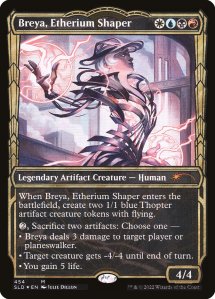
The Great EDH Challenge: Yore-Tiller โ€“ Breya, Mud Shaper

Decklist: https://tappedout.net/mtg-decks/breya-mud-shaper/


Power Level: 7.3

Breya is a powerful artifact commander that serves as interaction in the command zone, in addition to being an excellent outlet for infinite mana. This deck can’t produce infinite mana, but it does enjoy generating plenty of artifact tokens to use in sacrifice shenanigans.

I’ve always preferred the “mud” border of the old artifacts, so I decided to make a deck themed around them. The release of the Brother’s War commander precons made this deck idea far more viable, and much of this deck uses cards from those. I could have increased the power and budget of this deck by including numerous other powerful “retro” artifacts, but I limited myself to only a few of those, such as Metalworker. Despite the deckbuilding limitation, the deck still has plenty of synergy, mainly revolving around artifact token generation and sacrifice.

Cards like Brudiclad, Telchor Engineer and Urza, Chief Artificer provide excellent free token generation on each of our turns. Other cards like Sai, Master Thopterist and Sharding Sphinx make us work a bit harder for our tokens, but not too hard. We use these artifact creature tokens to attack our opponents and to interact with them thanks to Breya and other cards like Oni-Cult Anvil. There is also a large amount of draw engines available in this deck. Bident of Thassa draws a card for each crature that deals combat damage, and is perhaps the best way to draw a large amount of cards in the deck. Value engines such as Thopter Shop and Thopter Spy Network are far more gradual and consistent ways to draw cards.

This deck is a more traditional EDH deck, where the playstyle tends to be a mix of battlecruiser and tinkering. Once we have a large amount of artifacts on the battlefield, we typically can do all sorts of things to both generate more value and expand our board presence. This deck wins with combat damage at least half of the time, usually with large constructs created by Urza, Lord High Artificer and Digsite Engineer. The other half of wins are attained through combos involving Ashnod’s AltarMarionette MasterSharuum the Hegemon, and Sculpting Steel. It always helps to have a way to close out a game using a combo that can be interacted with by casual, less-powerful decks.

I have plenty of artifact decks, as it is my favorite archetype in Magic. This deck does the usual tinker-y things that those decks tend to do, with a specialization in token generation. If you like having a lot of artifacts, then this is a fun deck to play.

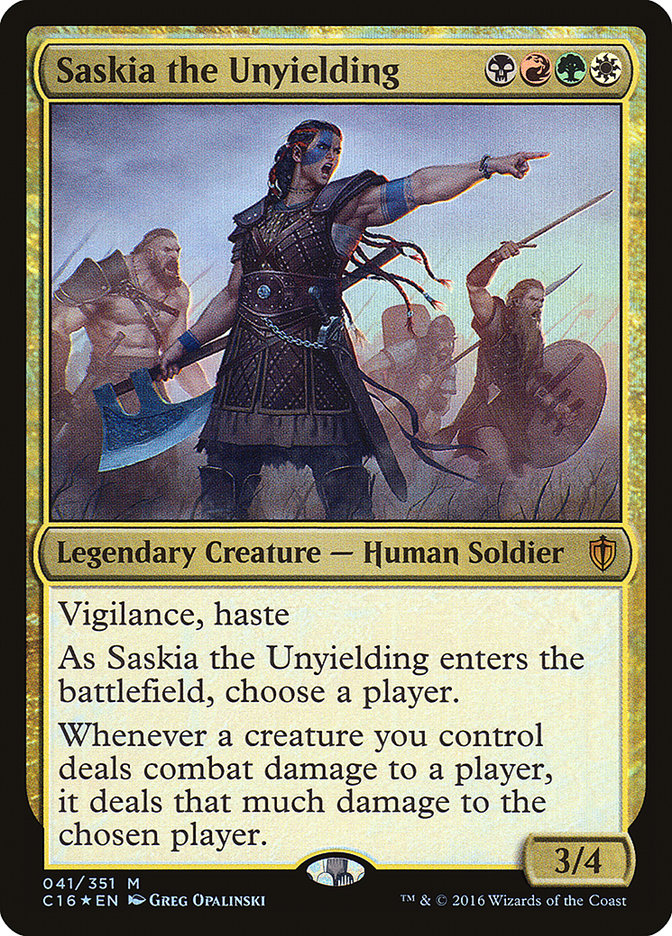
The Great EDH Challenge: Dune-Brood โ€“ Saskia, Soldier Girl

Decklist: https://tappedout.net/mtg-decks/saskia-soldier-girl/


Power Level: 6.1

<<< Hey guys, it’s been a long time. Life has been hectic this past year, and I have done a lot of moving around, but I’m back at home and ready to finally complete this challenge. Just three more decks to go after this one! >>>

Saskia was created to accelerate the aggro strategy in commander by allowing you to kill your opponents even more quickly. The way that Saskia puts pressure on the chosen player can overwhelm that person, even if they have blockers or pillow fort cards in play. Simply attack an opponent who can’t defend themselves, and watch that pesky protected opponent’s life total get whittled away. And if you want to be extra efficient, then you can attack the chosen player directly to do double damage. And with haste, this soldier girl comes out swinging. I always love a good hasty commander!

In this deck, Saskia leads an army of soldiers to storm and control the battlefield. We storm the board with creature tokens with cards like Call the Coppercoats and Deploy the the Front, while controlling the board with powerful legendary creatures such as Thalia, Heretic Cathar and Odric, Master Tactician. There are several powerful lords in the deck that really push our 1/1 tokens over the edge, such as Rick, Steadfast Leader and Captain of the Watch.

We are spending our first turns building up a board presence of creatures in preparation of Saskia’s arrival on the battlefield. Esper Sentinel into Ballyrush Banneret into Field Marshal and Valiant Veteran is one of the best curves you can get. When Saskia comes out, we want her to have enough bodies to do some real damage. This deck has several high-cost, high-impact cards, so be mindful that our early and mid-game tends to be quite slow. One-spell a turn is to be expected while playing this deck. And as always, there are a few infinite combos in the deck to close the game out in the late-game:

Ashnod’s Altar + Nim Deathmantle + Captain of the Watch/Torsten, Founder of Benalia = Infinite Creatures and Infinite Colorless Mana

Shielded by Faith + Siona, Captain of the Pyleas = Infinite Creatures

And add Warstorm Surge to either of these combos for infinite damage!

If you enjoy tribal decks with a lot of synergy, this is a pretty dependable option. It could be made more efficient and low-to-the-ground by replacing the high mana value cards with lower cost options. Soldiers are a tribe that are always being expanded, due to their prevalence in nearly every set and plane. This deck is a great template for those who like to improve their armies by tinkering with an ever-evolving deck. You can have fun with the deck as it already is, just be mindful that it is prone to being devastated by board wipes.

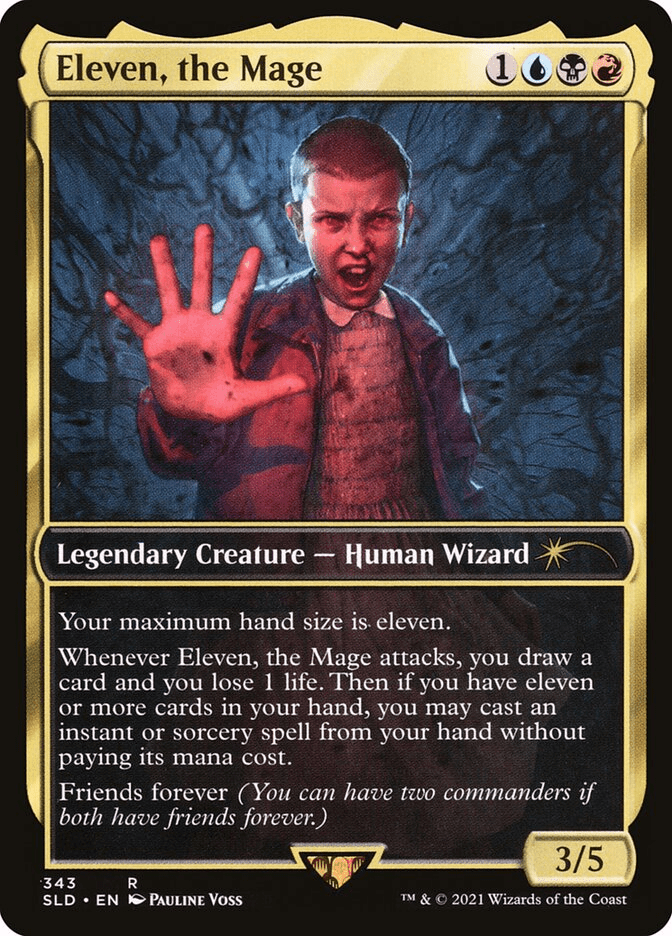
The Great EDH Challenge: Glint-Eye โ€“ Max Eleven Bad Girls

Decklist: https://tappedout.net/mtg-decks/max-eleven-bad-girls/


Power Level: 8.75

Happy Halloween!

When I made this deck, Max and Eleven were unique cards, and the Universe Within cards did not yet exist. Thus, I will refer to them as the commanders, despite them being “subtitled” cards now.

This is not a Stranger Things themed deck, despite the commanders. I also made this deck before Season 4 came out, so it has a bit of extra meaning now, so that’s neat. In any case, this is my all female deck, to compliment my Shirtless Studs deck. The theme of the deck revolves around “bad” girls, aka cards that depict cool, powerful, or just sinister females. All my nonland, non-artifact cards prominently feature a female in their art except for one card, [[Sea Gate Restoration]], due to it synergizing perfectly with Eleven. Liliana is featured prominently in the deck, since she is “bad” in both the cool way and the sinister way.

Eleven and Max don’t work particularly well together, as they synergize with two different play styles. However, it is because of their differences that the deck is highly versatile. Max having haste lets her aggressively come out and put pressure on player life totals and early-game planeswalkers. I am rarely casting two spells in the early and mid game, but she does generate clues later in the game, and can untap very useful creatures like [[Bloom Tender]] and [[Cormela, Glamour Thief]]. Eleven on the other hand is the haymaker. She attacks well AND she blocks well. In the mid game, she is oftentimes a Phyrexian Arena that deals 3 commander damage to an opponent. But in the late game, Eleven casts me into big spells like [[Rise of the Dark Realms]] that oftentimes lead to game-winning combos.

This is a dynamic deck that does a bit of everything in order to win. I usually win utilizing a random-oriented combo utilizing [[Arcane Bombardment]] and [[Time Warp]], which can be assembled with the numerous tutors in the deck. However, this usually doesn’t happen until 8+ turns into the game, so we will spend the early and late game controlling the board and putting pressure on our opponents. Ramping with signets and playing Max and Eleven is a good way to spent the early game. Getting off a turn four [[Culling Strike]] into another spell is usually very powerful, as well as putting down value engines like [[Necropotence]] and [[Rhystic Study]]. Tutoring makes the deck very toolbox-y, getting us a number of specific forms of removal when we need it, like [[Prismari Command]] or [[Assassin’s Trophy]].

One of the most powerful cards in this deck is [[Mizzix’s Mastery]]. I’d never played with it before, but it can be borderline broken. I usually cast [[Final Parting]], getting a big spell like [[Aminatou’s Augury]] and Mizzix’s Mastery. Casting an eight mana spell that can get you over 10 mana in other spells for four mana is pretty awesome. Top-decking Mizzix’s Mastery in the late game with a graveyard full of goodies is a true joy. I love the card so much.

This is a very fun deck to play, and wins most of the time against a wide variety of other types of decks. WotC making Eleven a Four mana 3/5 is oftentimes a head-scratcher to a lot of people I play with, but I’ve got no complaints. If you like attacking, destroying things, tutoring, and taking extra turns, then this is definitely the deck for you!

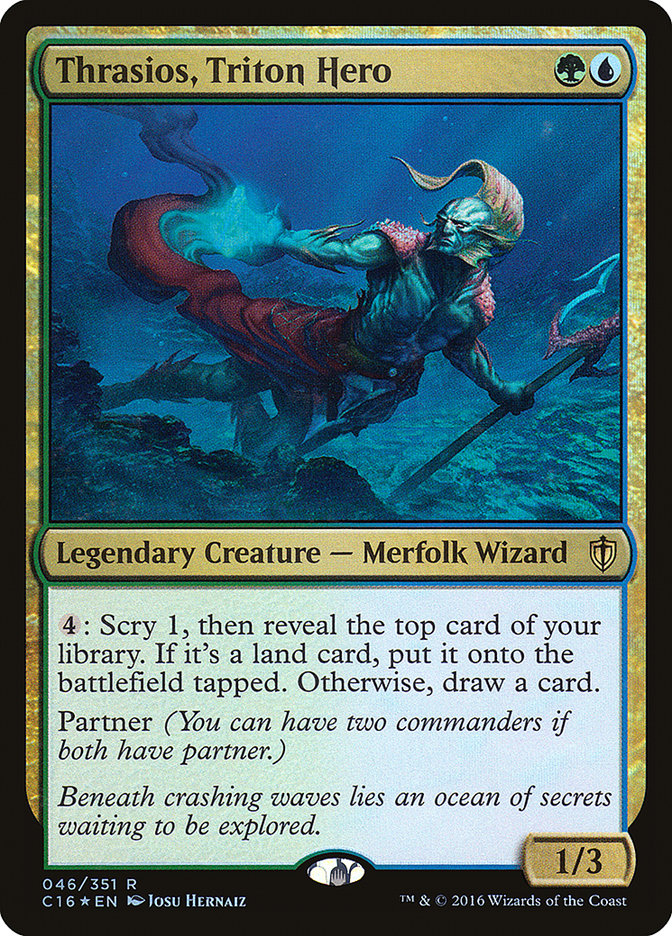
The Great EDH Challenge: Ink-Treader โ€“ Thrasios and Bruse’s Shirtless Studs

Decklist: https://tappedout.net/mtg-decks/shirtless-studs-thrasios-and-bruse


Power Level: 6.1

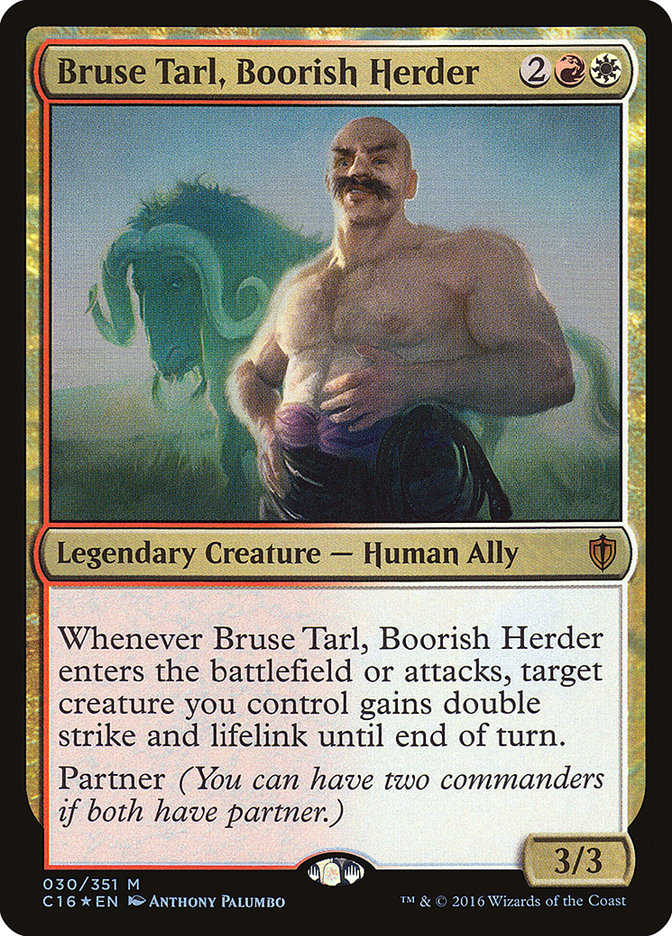
The first of my 4-color decks is one with a theme that is very near-and-dear to me. Although the best of them are in black, I decided to go with a shirtless men theme for this one. It was even more of a definite choice when I realized that both Bruse Tarl and Thrasios are shirtless! When I realized that, I felt that my decision to make this deck was divinely-ordained! Haha, but anyway, yeah, this is a deck where each non-artifact and non-land card depicts a shirtless male character.

This deck has a wide mix of cards, but there are two main themes to it; Beatdown and Pillow-fort-y Control. I guess some would call it a Midrange deck, but I have never been too clear about what midrange actually is. In any case, this deck can prevent us from being clobbered by making it harder for our enemies to attack us via interaction and tax effects. It can also straight up clobber our enemies with big, value-generating creatures. It is a bit janky, but that arises more from the gimmick of requiring shirtless hotties on so many of the cards.

We spend the early game setting up, doing things like ramping and protecting ourselves. Playing Thrasios early is usually the best bet, because he can make our draws better as we approach the mid-game. We also tend to play signets and small value-generating creatures like Orcish Lumberjack and Dryad of the Ilysian Grove in the early game. Expect to do very little in the first 4 turns, and spend that time sizing up your opponents so that you can decide what strategy you will be using in the later turns.

For the pillow-fort-aspect of the deck, we have a few interesting tools at our disposal. Collective Restraint and Ghostly Prison are the obvious pillow-fort cards. We also utilize interactive planeswalkers like Ajani Vengeant and Oko, Thief of Crowns to further keep pressure off of us. Oko is probably the best card in the deck, and the games this deck wins usually involve using Oko to turn off enemy commanders. Komainu Battle Armor is great at making threatening opponents attack people other than us, while Frozen Aether slows opponents and keeps hasty decks at bay. Balancing Act is a very interesting Balance-effect that can really save us when we fall far behind our opponents, or when one opponent gets really far ahead of everyone else.

And for the Beatdown-aspect of the deck, we have plenty of muscular studs to crush our opponents. Frost Titan and Inferno Titan do a lot of work when they land, and are absolute houses if they are able to attack a few times. It is a crime that there isn’t a version of Sun Titan that depicts him shirtless, but we make do. Ruric Thar, the Unbowed just shuts down entire archetypes that our opponents are playing while also being a very good attacker. Xenagos, God of Revels turbo-charges our team, especially after we play Bruse Tarl to give our biggest creature double strike and lifelink. Also, never underestimate the power of Garruk Wildspeaker‘s -4 to overrun everyone, especially since he can do it the turn after you play him. And lastly, an entwined Savage Beating is oftentimes enough to destroy at least one opponent when we have at least 3 big boys out.

This deck can be fun to play, but keep in mind that it isn’t much stronger than a precon. If you are playing in a high-power playgroup, this deck will not perform well enough to keep up. This is a slow deck whose win-condition involves attacking with creatures. There is only one infinite combo in this deck that can’t even be tutored for, involving Sage of Hours and Simic Ascendancy. I’ve never pulled it off before, probably because it takes a total of 19 mana to win with it. If you are fine with a silly low-powered deck that has a lot of variance between games, this is a great deck for you. Pull it out when you are playing with a bunch of new players for maximum enjoyment.

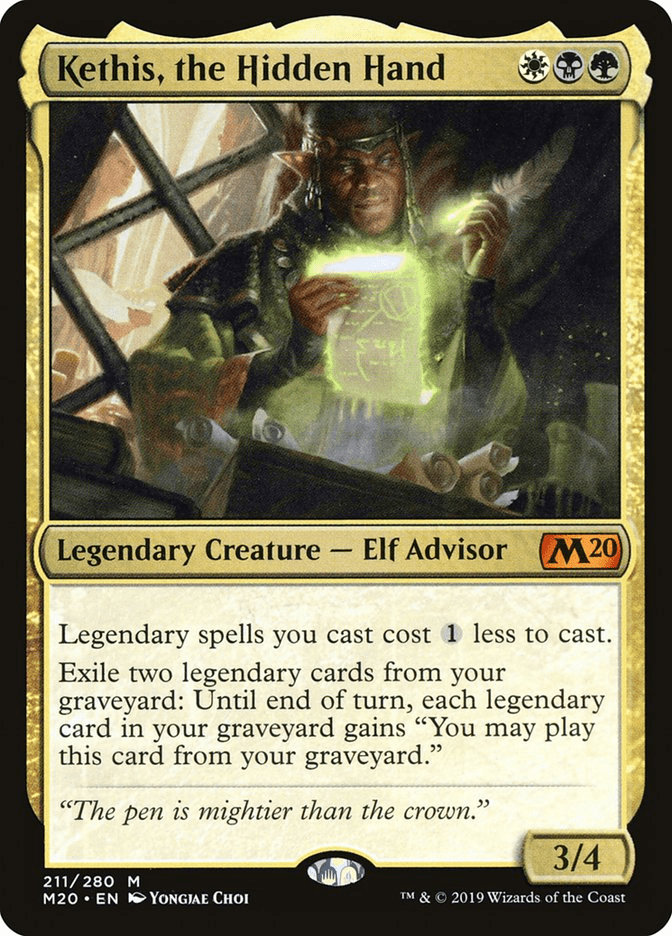
The Great EDH Challenge: Abzan โ€“ Kethis Black People

Decklist: https://tappedout.net/mtg-decks/kethis-black-people


Power Level: 6.5

Yes, I know that there aren’t actual “Black” people in MtG, but I did it. This is a deck featuring dark-skinned characters, many of which are legendary. And hey, there is one actual Black person in the deck;ย Michonne, Ruthless Survivor!

The rule is if the creature or creatures are humanoid, there has to be a dark-skinned person featured prominently within the card art. In regards to that rule, there are two cards that some may be a bit torn about. Ob Nixilis Reignited in his Secret Lair art looks pretty black, especially when you look at his facial features, though I know that he was portrayed as a white character when he was human. Captain Sisay is quite the redbone, and many I have played with don’t see her as dark-skinned persay, but she is too good to pass up in this deck. Heck, she is Jamuraan, which is basically Dominaria’s Africa, so yeah.

This deck plays much like a precon; we simply play our cards and hope that we can win somehow. There aren’t any obvious combos or anything that high-powered, just a bunch of random cards that are a mix of interaction, value, and threats. Humorously enough, the most powerful card in the deck is probably Peacekeeper. There have been numerous games in which she has effectively stopped all combat for 10+ turns, simply because my opponents couldn’t find a way to get rid of her simple 1/1 body. She can really help us build up our board state without fear of being overwhelmed by our opponents. And hey, we can always sac her on our upkeep so that _we _can then attack.

There are many planeswalkers in this deck, and they tend to put in a great deal of work. Kaya the Inexorable both protects our creatures (such as Peacekeeper) and removes problem nonland permanents. Her ult is stellar in our legends-matter deck, and can be gotten too relatively quickly. Vivien, Monsters’ Advocate is a house who just does it all. She can tutor up creatures (such as Peacekeeper) onto the battlefield, and also make versatile 3/3’s that can be defensive and offensive threats. Kaya, Ghost Assassin can practically o-ring a commander each turn, essentially eliminating commander-dependent decks.

This deck mainly wins by assembling a board of sheer value, then overrunning our opponents. Our planeswalkers definitely help with that, but there are other ways to do so in our deck. Mangara, the Diplomat is phenomenal card draw, especially in the mid-to-late game. Sarulf, Realm Eater is removal-on-a-stick, especially against tokens. Crovax, Ascendant HeroAscendant Evincar, and Kaervek, the Spiteful are all mini Elesh Norns that can hose many go-wide decks.

All in all, this is an original deck that offers a more casual form of play. I always get humorous comments and compliments on this one, mainly because of its silly gimmick. It also harkens back to a day when people made EDH decks to show off their style, not so much their winning ability. Though I must admit, this deck is deceptively powerful, despite being a themed deck. I know many won’t put this together and play it, as it is admittedly jank-city, but I appreciate anyone who can look it over and appreciate what I tried to do. ๐Ÿ˜€